Helping learners understand change, practice flexibility, and build skills for when life does not go as planned
If your child gets upset when plans change, you may have wondered why something that seems relatively small can lead to such a big reaction. A canceled activity, a different route home, an unexpected visitor, or even a change in what is happening after dinner might not seem significant to us. For a learner who relies on predictability, however, that change can feel much bigger.
Many neurodivergent learners find comfort in knowing what is going to happen next. Repetition, routines, order, and clear expectations can make the world feel easier to understand.
So when the expected suddenly becomes unexpected, the challenge may be about much more than disappointment.
The learner may be trying to understand why something they believed was going to happen is suddenly no longer happening.
The good news is that learners can build their ability to respond to change through teaching, practice, and experience over time.
In fact, families can work on this skill through the WonderKids Self Management Module. Lessons such as Being a Flexible Thinker and Dealing With Change give learners opportunities to explore what can happen when life does not go as expected and practice skills for responding.
Families who are ready to begin can start with Self Management or choose the complete WonderKids experience and begin working on these skills at home. WonderKids is designed to let learners move at their own pace, revisit lessons, and practice skills again as they grow.
Why Can Your Child Get Upset When Plans Change?
Think about how much easier life can feel when we know what to expect.
We know where we are going and who will be there. We understand what is supposed to happen and what comes next.
For some learners, that predictability is especially important. They may rely heavily on routines, repetition, clear expectations, or more concrete and black-and-white ways of understanding the world.
If the plan is, “After school, we’re going to Grandma’s house,” that creates an expectation.
Then Grandma calls and says she isn’t feeling well.
The plan changes.
As adults, we may quickly understand why. Grandma is sick. We will visit another day. We’ll do something else instead.
For the learner, however, the difficult part may not simply be disappointment about missing Grandma.
The plan was Grandma’s house. Now the plan isn’t Grandma’s house.
Suddenly, something no longer matches what the learner expected.
The Raising Children Network explains that autistic children and teenagers often value the certainty and predictability of routines and can find changes to familiar activities, environments, people, or plans stressful. It also recommends preparing and practicing for both expected and unexpected changes. Their guidance for helping autistic children cope with change includes strategies families can practice while a learner is calm.
Understanding that can help us look differently at what happens next.
Look Beyond the Behavior You Are Seeing
When a child gets upset when plans change, adults may see refusal, arguing, shutting down, crying, yelling, or a learner who simply will not move on.
From the outside, it might look like:
“Why are we making such a big deal about this?”
But that question can miss what’s happening underneath.
The learner may be trying to make sense of something that no longer matches what they understood was going to happen.
That doesn’t mean every difficult response should simply be ignored. Learners still need support in developing safe and appropriate ways to communicate frustration, disappointment, or confusion.
But understanding why the moment may be difficult gives us a much better starting point for teaching what to do next.
The goal isn’t to make a learner stop caring about routines or predictability.
Instead, we can help build another skill alongside them:
Sometimes plans change. What can I do when that happens?
Explaining More Isn’t Always Teaching More
When a plan changes, adults naturally want to explain why.
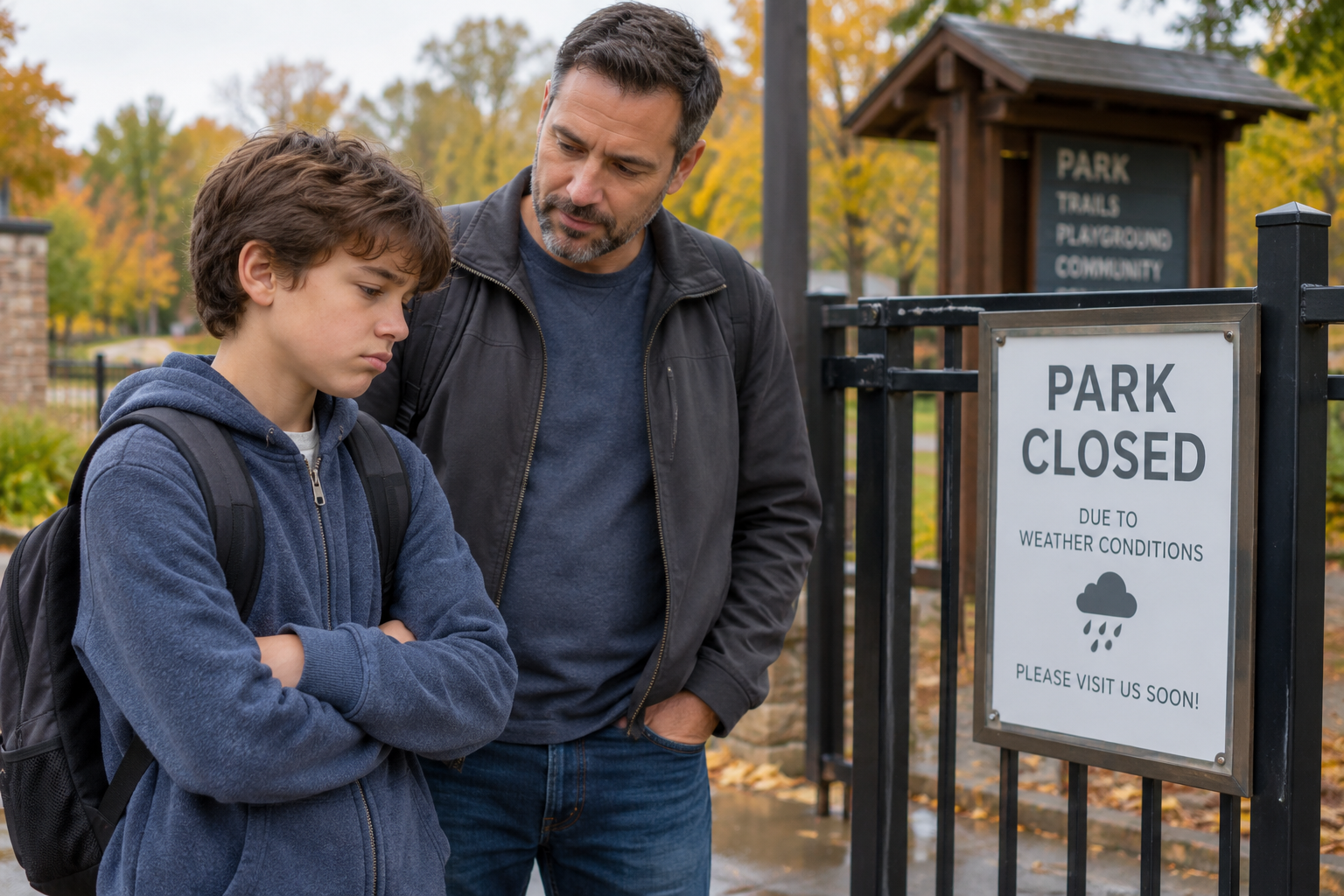
“The park is closed because it’s raining.”
“Your teacher isn’t here because she’s sick.”
“We can’t go to the restaurant because it closed early.”
“The weather changed our plans for the game.”
And sometimes that explanation is helpful.
But we can also explain something until we’re blue in the face and still not teach the larger skill.
The learner may understand every word of our explanation and still have difficulty with the fundamental idea that they expected one thing to happen and now something different is happening instead.
That’s why teaching flexibility involves more than explaining the reason for one particular change.
We have to practice the concept itself.
Think About Learning to Ride a Bike
Imagine teaching someone how to ride a bike.
We wouldn’t sit them down for an hour, explain every possible reason they might lose their balance, and then expect them to hop on and ride perfectly.
We would explain enough to get started, then practice together. Along the way, we’d provide support and keep trying.
Eventually, we’d practice in different places and under different circumstances.
Learning how to respond when plans change can work in much the same way.
A learner can first explore the idea when everything is calm. We can talk about what it means when a plan changes, model different examples, and practice possible responses.
Then, when a real change happens, the learner has already practiced the concept.
That’s an important part of how WonderKids works. A learner can watch a lesson demonstrate a skill, practice it through examples and activities, revisit it when needed, and then look for opportunities to use that learning at home, at school, and in the community.
The screen isn’t the finish line.
The goal is to take what was learned on the screen and use it in real life.
Practice Change When Nothing Is Wrong
Teaching flexibility for the first time becomes much harder when an unexpected change has already overwhelmed a learner.
So don’t wait for the hardest moment to begin practicing.
During a calm moment, try simple examples:
- “We planned to have pizza, but what could we do if the pizza place had to close?”
- “We planned to go outside. What could we do if it started raining?”
- “What could we do if our teacher couldn’t come to school tomorrow?”
- “We usually drive this way. What could we do if the road was closed?”
You don’t have to practice every possible thing that could ever change.
Start with one.
Talk about what changed. Give the learner time to process it. Then practice what they might say or do next.
Some learners may benefit from words or phrases such as:
- “I don’t like that the plan changed.”
- “What’s the new plan?”
- “Can you tell me what happens next?”
- “I need a minute.”
- “Can I have some help?”
Other learners may communicate those same ideas through pictures, visual supports, communication devices, or another method that works for them.
There isn’t one perfect response we’re trying to teach.
We’re helping learners build options.
Predictability and Flexibility Can Exist Together
Teaching flexibility doesn’t mean removing routines.
Routines can be incredibly helpful. Predictability can help learners understand expectations, prepare for what is coming, and move through the day with greater confidence.
We don’t need to take that away in order to teach that changes sometimes happen.
Instead, we can add flexibility to the skills a learner already has.
A visual schedule, for example, can still show what is expected while also creating opportunities to practice what happens if one part changes. The Raising Children Network even suggests deliberately building space for uncertainty into visual schedules and gradually practicing unexpected changes.
The message isn’t:
“Stop expecting things to happen a certain way.”
It’s:
“It’s okay to have a plan. Let’s also practice what we can do if the plan changes.”
Give Learners a Way to Communicate About the Change
Sometimes we focus so much on getting through the changed plan that we forget the learner may need a way to tell us how they feel about it.
They are allowed to be disappointed.
They are allowed to prefer the original plan.
They are allowed to need time to adjust.
Self management doesn’t mean never becoming frustrated, upset, or overwhelmed.
It means building skills for recognizing those feelings and having safer, more effective ways to respond.
This is also where other WonderKids learning areas can work alongside Self Management. Self Advocacy can support learners in communicating what they need, while Social Awareness can help learners better understand the people and situations around them.
The skills don’t live in separate boxes in everyday life.
They work together.
Don’t Forget to Say “Nice Catch!”
I was recently watching a child play catch with her dad.
Every time she caught the ball, people naturally responded:
“Nice catch!”
“Good job!”
We do that without even thinking about it. We notice when someone uses a skill successfully, and we celebrate it.
We should be doing the same thing when learners handle change.
Imagine your child was expecting to stop for ice cream, but the shop is closed.
Maybe they’re disappointed. Maybe they need a minute. But then they accept the new plan and move forward.
Notice that.
“You really wanted ice cream, and that wasn’t what you expected. You did a great job handling that change.”
That matters.
The Raising Children Network similarly recommends praise and positive reinforcement as children practice coping with changes.
Too often, when a difficult moment goes well, adults simply feel relieved and move on.
But the learner just used a skill.
Tell them.
Practice Does Not Mean Perfect
The goal is not for a learner to reach a point where every unexpected change is easy.
That’s not realistic for any of us.
Adults get frustrated when flights are canceled, appointments move, restaurants lose reservations, meetings change, or the thing we planned our entire Saturday around suddenly isn’t happening.
We have simply had many more years to experience those moments and develop ways to respond.
Learners deserve opportunities to build those skills too.
If your child gets upset when plans change, practice can make change feel more familiar and manageable. It gives learners experiences they can draw from the next time the expected becomes unexpected.
And progress may look different from one learner to another.
Maybe the reaction is shorter. They might ask what the new plan is, use a coping strategy, or tell you they’re disappointed and find a way to move forward. Sometimes progress simply means recovering a little faster than the last time.
Those are all things worth noticing.
Take the Skill Beyond the Screen
We designed WonderKids around a simple idea: learners need opportunities to practice meaningful skills beyond a lesson.
Learners can watch examples, explore situations, answer questions, and revisit concepts. But families can then take those ideas into everyday life.
If your learner has been working on dealing with change, look for opportunities to practice at home.
Share strategies that are working with teachers or other members of the learner’s support team.
Use similar language when possible.
And when an everyday change happens, connect it back to what the learner has practiced.
Families can also see a WonderKids lesson in action before deciding whether WonderKids is right for them. The preview provides a look at the video instruction, real world examples, visual supports, guided practice, and activities learners experience within the platform.
Child Upset When Plans Change? Start With One Skill
If your child gets upset when plans change, you don’t have to prepare for every possible unexpected event.
Start smaller.
Help them understand what it means when a plan changes.
Practice one example.
Give them a way to communicate how they’re feeling.
Talk about what they can do next.
And when they use the skill, notice it.
Families who want structured opportunities to work on flexibility, coping skills, and dealing with unexpected situations can explore the WonderKids Self Management Module or choose a WonderKids learning option and get started.
And if you’re thinking about how these skills connect to school, our article How Can I Help My Child Prepare Socially for Back to School? explores additional ways families can practice communication, social awareness, self management, and self advocacy throughout the school year.
The goal isn’t to make learners like every change.
It isn’t to take away the predictability that may help them understand their world.
It’s to give them more tools for the moments when life doesn’t follow the plan.
Because when the expected becomes unexpected, knowing what to do next is a skill too.