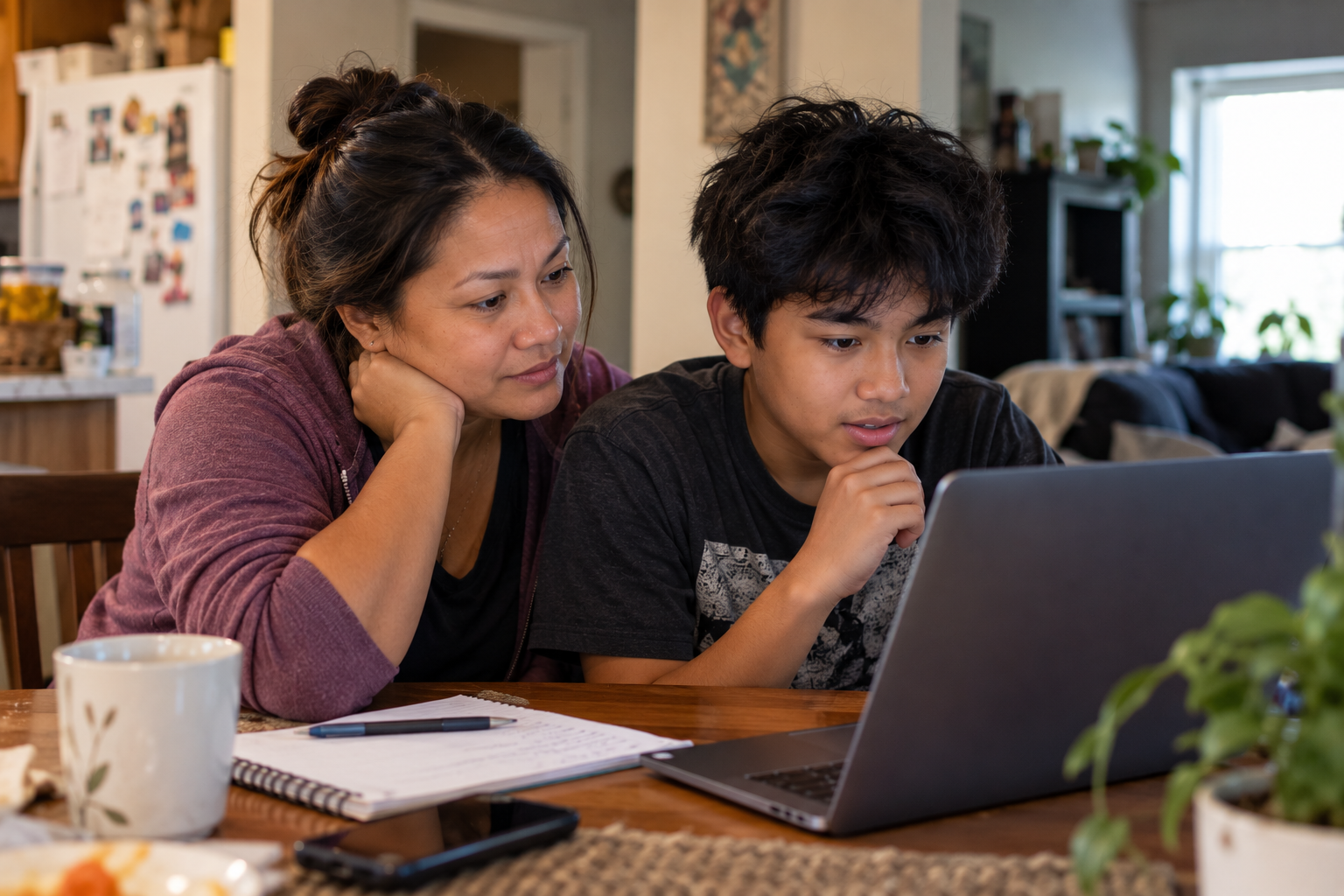
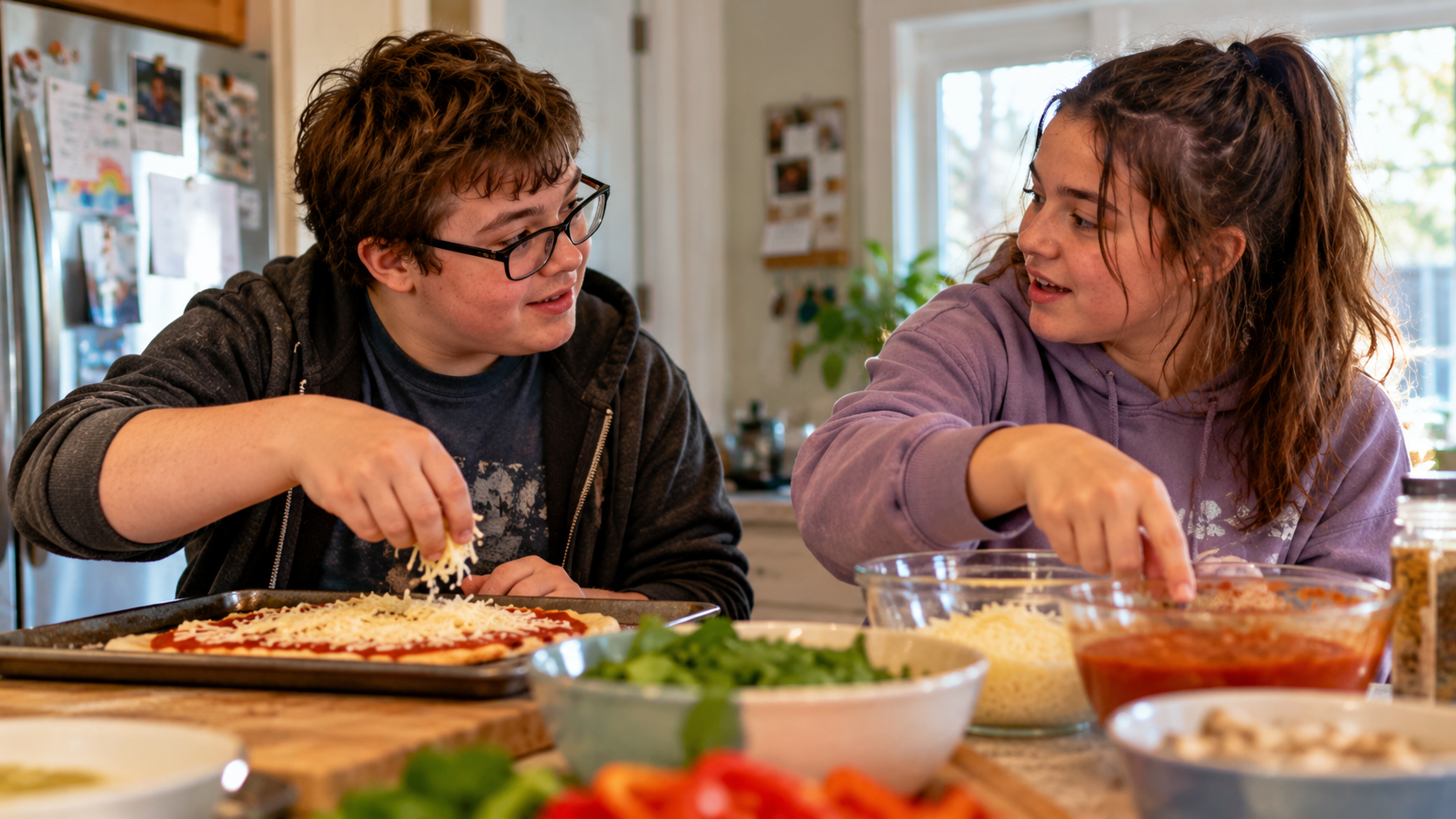
Learning how to teach social skills at home starts with everyday opportunities to practice, build confidence, and develop meaningful skills.
When thinking about how to teach social skills at home, I sometimes find myself comparing the process to learning how to ride a bike. Think about the first time you learned. Someone probably explained what to do, showed you how the pedals worked, and maybe even held onto the back of the seat while you tried to balance.
But imagine if that person simply pointed to someone riding a bike and said, “Watch what they’re doing. Now go do that.”
For most of us, that probably wouldn’t have worked very well.
Yet when it comes to social skills, we sometimes expect children to learn in exactly that way.
We expect them to know how to start a conversation, recognize when someone wants to talk, understand another person’s feelings, or ask for help when something becomes difficult. We may assume that because they’ve watched other people do these things, they should somehow know how to do them too.
But social skills don’t always develop simply through observation. For many children and teens, particularly those with autism or other developmental differences, these skills benefit from direct instruction, opportunities to practice, and support along the way.
And that’s where families can make a tremendous difference.
Learning how to teach social skills at home doesn’t mean turning your living room into a classroom. It means recognizing the opportunities already happening around you and finding ways to make learning a little more intentional.
Why Social Skills Sometimes Need to Be Taught Differently
When we think about social skills, we often think about making friends, having conversations, or getting along with others.
But social skills involve so much more.
They include recognizing when someone is interested in a conversation, understanding personal boundaries, expressing feelings, asking for help, handling disagreements, and knowing how to respond when something doesn’t go as expected.
That’s a lot to learn!
And what makes these skills particularly challenging is that social situations are rarely predictable.
A child might know exactly how to greet a familiar teacher but feel unsure about approaching another student. A teen might comfortably talk with family members about a favorite interest but struggle to recognize when someone else wants to contribute to the conversation.
Neither situation necessarily means the child doesn’t want to connect with others.
Sometimes, they simply need additional opportunities to understand what is happening and explore different ways to respond.
We also need to remember that social communication looks different from person to person. The goal isn’t to make every child communicate or interact in the same way. It’s to help them develop skills that support their own relationships, needs, preferences, and independence.
How to Teach Social Skills at Home Without Making Everything a Lesson
One of the things I appreciate about teaching social skills is that we don’t always need a special activity or a carefully planned lesson. When families ask how to teach social skills at home, I often encourage them to begin by looking at what’s already happening around them.
Everyday life gives us opportunities to practice.
Think about something as simple as deciding what to have for dinner.
A parent might ask, “Would you rather have pizza or tacos?”
That small conversation creates an opportunity for a child to express a preference, listen to another person’s opinion, and perhaps work through a disagreement if everyone wants something different.
Or consider what happens when a family is getting ready to leave the house.
Someone can’t find their shoes. Another person is running late. Plans change because it’s raining.
These moments might seem ordinary, but they can involve communication, problem-solving, flexibility, and self-advocacy.
The important part is recognizing that we don’t need to teach all those skills at once.
In fact, trying to do too much can make learning harder.
Instead, choose one skill that would be meaningful for your child and look for opportunities to practice it naturally.
Start With One Skill That Matters
Let’s say your child has difficulty asking for help.
Rather than working on several communication skills at the same time, begin with that one.
Talk about what asking for help might look or sound like. Depending on your child’s communication preferences, that could mean using spoken words, a gesture, a picture, or a communication device.
You might model a simple example:
“I can’t reach that. Could you help me?”
Then look for a comfortable opportunity to practice.
Perhaps your child needs help opening a container or finding something around the house.
The goal isn’t to create frustration so they have to ask. It’s to help them recognize that asking for support is an available option.
And when they do communicate that need, acknowledge it.
Over time, the same skill can be practiced in other settings, such as school, a store, or a community activity.
That’s how something introduced at home can begin to become useful in everyday life.
Show the Skill Instead of Only Explaining It
Here’s something worth thinking about.
How many times have we told a child to “be polite,” “use your words,” or “be a good friend”?
Those reminders usually come from a good place. But they can also leave a child wondering exactly what we’re asking them to do.
What does being a good friend actually look like?
What words could someone use when they want to join a conversation?
How might they tell another person that something is bothering them?
Sometimes, showing a skill is much more helpful than simply describing it. That’s an important consideration when thinking about how to teach social skills at home.
For example, if you’re helping a child learn how to join a conversation, you might demonstrate what that could look like.
You could say:
“I heard you talking about that new movie. I’ve seen it too. What did you think?”
Then talk about why that approach might work.
The child has a chance to see the skill, understand the purpose behind it, and practice in a comfortable setting.
This approach connects with instructional practices such as modeling, which has been identified in autism education research as a way to support skill development.
Families can learn more about these approaches through the National Professional Development Center on Autism.
And while modeling can be helpful, it’s important to remember that not every child will learn best through the same approach. Some may benefit from visuals, written examples, role-playing, or additional processing time.
The goal is to find what makes the skill understandable and accessible for that learner.
How to Teach Social Skills at Home in Small, Manageable Pieces
Let’s go back to our bike example.
We wouldn’t expect someone to learn how to balance, pedal, steer, and navigate traffic all at once.
We break the process into smaller pieces.
Social skills deserve that same consideration.
Take having a conversation.
For someone who finds conversations challenging, that one activity can involve several different skills:
- Recognizing an opportunity to begin talking
- Choosing something to say or ask
- Listening to or processing another person’s response
- Deciding what to say next
- Recognizing when the conversation is ending
That’s quite a bit happening in what might appear to be a simple interaction.
Instead of expecting a child to master the entire process, we can begin with one part.
Maybe this week the focus is asking someone a question about an interest they share.
Next week, the focus might be recognizing that the other person has something they want to contribute.
And sometimes, we may spend several weeks practicing the same skill.
That’s okay.
Learning isn’t a race, and repetition isn’t a sign that something isn’t working.
For many learners, repetition provides the familiarity and confidence needed to use a skill in a different situation.
This is also part of the thinking behind the WonderKids Conversations Module, which helps break different aspects of communication into more manageable learning opportunities.
Give Children Opportunities to Make Choices and Speak Up
When families think about social skills, the focus often turns toward how children interact with other people.
But an equally important part of social development is learning to understand and communicate our own needs.
That includes knowing when to say no, asking for clarification, expressing discomfort, and recognizing when we need help.
These are self-advocacy skills.
And they’re important at every age.
Imagine a child who doesn’t understand the directions for a classroom activity.
They may sit quietly, become frustrated, or avoid participating because they don’t know how to ask for clarification.
Now imagine that same child has practiced a few different ways to communicate:
“Can you explain that again?”
“Can you show me?”
“I need help getting started.”
Those are practical skills that can make a real difference.
At home, families can encourage self-advocacy by offering meaningful choices, listening to preferences, and respecting appropriate boundaries.
If a child doesn’t want to hug a relative, for example, that can become an opportunity to talk about personal boundaries and other ways to greet someone.
The purpose isn’t to make children more agreeable or compliant.
It’s to help them recognize that their voice matters and that they have ways to communicate their needs.
The WonderKids Self Advocacy Module explores skills connected to expressing needs, asking for help, personal safety, and speaking up for oneself.
Remember That Practice Doesn’t Always Look Like Progress
One of the more challenging parts of supporting skill development is recognizing that progress doesn’t always happen in a straight line.
A child may successfully practice a conversation at home and then struggle to use the same skill at school.
A teen may demonstrate a coping strategy during a calm moment but have difficulty remembering it when they’re overwhelmed.
That doesn’t necessarily mean the learning has disappeared.
Using a skill in a new setting, with different people or under different circumstances, can require additional practice and support.
Sometimes, the environment itself makes a difference.
A busy cafeteria is very different from a quiet kitchen. Talking with a familiar family member is different from approaching someone you’ve never met.
So rather than immediately assuming a child hasn’t learned something, we can ask ourselves a few questions.
Was the situation more complicated? Were there additional distractions? Did the child have enough time to process what was happening? Would a visual reminder or another opportunity to practice be helpful?
And perhaps most importantly, was this a skill the child wanted or needed to use in that moment?
Those questions can help us respond with support rather than frustration.
Practicing Social Skills at Home and Beyond the Screen
Technology can be a wonderful tool for teaching and practicing skills, but I think it’s important to remember what we’re ultimately trying to accomplish.
We’re not teaching social skills simply so a child can complete an online activity.
We’re teaching skills that can become useful in real life.
That distinction matters.
A child might watch a video demonstrating how to ask for help. They might practice identifying an appropriate response or work through an example of a social situation.
Those activities can help introduce and reinforce the skill.
But the next step is finding an opportunity to use what they’ve learned.
Perhaps after practicing how to start a conversation, a family encourages the child to try a greeting with a familiar neighbor.
After exploring ways to express preferences, they might practice making choices during a family activity.
After learning about personal boundaries, they might talk about what those boundaries look like with friends, relatives, or classmates.
The learning experience provides a starting point. Everyday life provides opportunities to use it.
And that’s one of the reasons WonderKids Digital was developed.
Building on Wesley Family Services’ experience with its in-person WonderKids programming, the digital program offers families a way to explore social skills through structured learning experiences that can be revisited and practiced at their own pace.
Rather than expecting children to learn everything in one sitting, families can focus on skills that are meaningful to them, revisit material as needed, and look for ways to connect the learning to everyday situations.
If you’d like to see how the program is organized and how its different learning components work together, you can take a look inside WonderKids Digital.
The overview video provides a closer look at how the program is designed to support learning.
Social Skills Learning Is About Building Opportunities
I often think we place a lot of expectations on children when it comes to social development.
We want them to make friends, communicate effectively, handle disagreements, understand other people’s perspectives, and know how to speak up for themselves.
Those are meaningful goals.
But they’re also skills that many adults continue working on throughout their lives.
How often have we walked away from a conversation wishing we’d handled it differently?
Or struggled to ask for help when we needed it?
Or found ourselves unsure about what to say in an uncomfortable situation?
If adults are still learning and practicing these skills, it makes sense that children and teens need opportunities to do the same.
And that’s really what I hope families take away from this.
You don’t need to teach every social skill at once. You don’t need to turn every family interaction into a teaching moment. And you certainly don’t need to expect perfection.
If you’re wondering how to teach social skills at home, my encouragement is to start with something meaningful.
Show what it might look like. Practice together. Give your child time to learn. Recognize the effort, even when the outcome isn’t exactly what you expected.
Then, when the opportunity presents itself, try again.
Because when we think about how to teach social skills at home, perhaps the most important thing to remember is that we’re not simply teaching children how to respond in a particular situation.
We’re helping them build the understanding, confidence, and choices they can carry into the world around them.